phylobuild provides fast neighbor-joining algorithms for phylogenetic tree construction in R. It wraps the highly optimized decenttree C++ library to deliver 10-100x speedups over ape::nj() for large datasets.
Performance
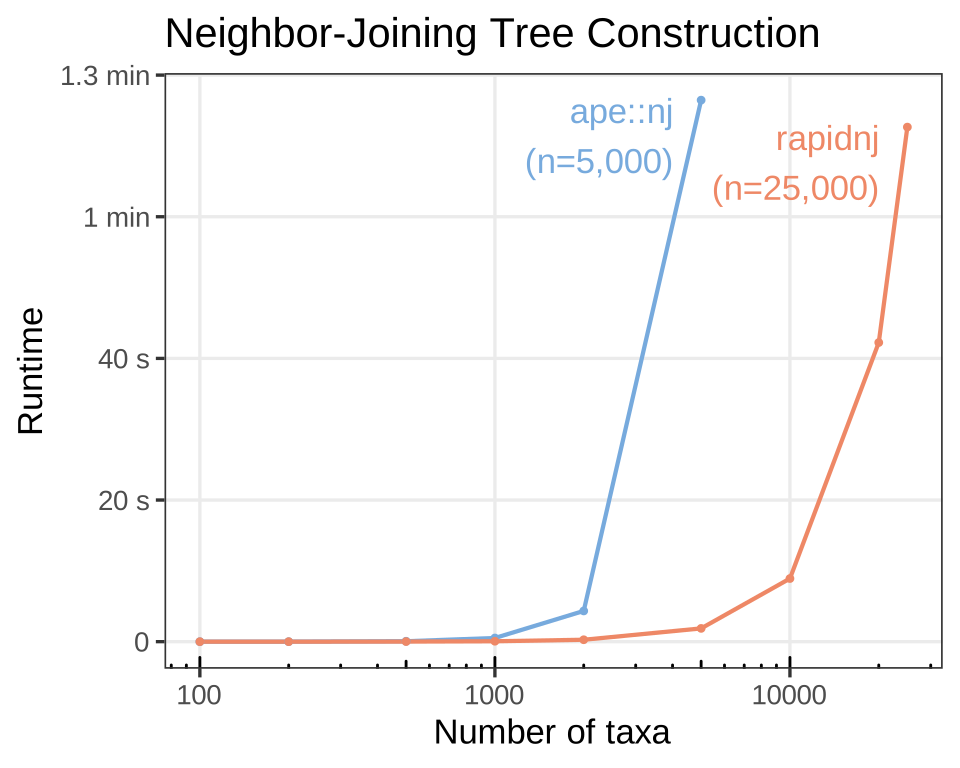
| Taxa | ape::nj() | phylobuild::fast_nj() | Speedup |
|---|---|---|---|
| 100 | 0.001s | 0.001s | ~1x |
| 500 | 0.07s | 0.02s | 4x |
| 1,000 | 0.55s | 0.07s | 8x |
| 2,000 | 4.5s | 0.25s | 18x |
| 5,000 | 70s | 1.5s | 47x |
For datasets with thousands of taxa, phylobuild makes neighbor-joining practical.
Quick Start
library(phylobuild)
library(ape)

# Load example primate data
data(primates)

# Build tree with RapidNJ (default, fastest)
tree <- fast_nj(primates)

# Plot the result
plot(tree, type = "unrooted")
The result is a standard phylo object, fully compatible with ape and the broader R phylogenetics ecosystem.
Available Algorithms
list_algorithms()
#> [1] "rapidnj" "nj" "bionj" "rapid_bionj"| Algorithm | Description | When to Use |
|---|---|---|
rapidnj |
RapidNJ with branch-and-bound | Default. Best for large datasets |
nj |
Classic NJ (Saitou & Nei 1987) | When exact NJ is required |
bionj |
BIONJ with variance estimates | When distance uncertainty matters |
rapid_bionj |
RapidNJ + BIONJ | Large datasets + variance weighting |
Example: Comparing Algorithms
# Build trees with different methods
tree_rapid <- fast_nj(primates, method = "rapidnj")
tree_nj    <- fast_nj(primates, method = "nj")
tree_bionj <- fast_nj(primates, method = "bionj")

# All produce valid phylo objects
class(tree_rapid)
#> [1] "phylo"
Acknowledgements
phylobuild is a thin wrapper around the excellent decenttree C++ library. All the heavy lifting—the algorithmic innovations, optimizations, and years of development work—was done by the decenttree authors:
- James Barbetti — Primary developer of decenttree
- Bui Quang Minh — Co-developer, IQ-TREE project lead
Their paper describes the scalable neighbor-joining implementations that power this package:
Barbetti J, Minh BQ (2023). “Decenttree: Scalable Neighbour-Joining for the Genomic Era.” Bioinformatics, 39(9), btad536. doi:[10.1093/bioinformatics/btad536](https://doi.org/10.1093/bioinformatics/btad536)
We are deeply grateful for their work in making fast, accurate phylogenetic inference accessible to the research community.
Citation
If you use phylobuild in your research, please cite the decenttree paper:
Barbetti J, Minh BQ (2023). “Decenttree: Scalable Neighbour-Joining for the Genomic Era.” Bioinformatics, 39(9), btad536. doi:[10.1093/bioinformatics/btad536](https://doi.org/10.1093/bioinformatics/btad536)
@article{barbetti2023decenttree,
  title   = {Decenttree: Scalable Neighbour-Joining for the Genomic Era},
  author  = {Barbetti, James and Minh, Bui Quang},
  journal = {Bioinformatics},
  volume  = {39},
  number  = {9},
  pages   = {btad536},
  year    = {2023},
  doi     = {10.1093/bioinformatics/btad536}
}
For the underlying algorithms, you may also wish to cite:
RapidNJ (Simonsen et al. 2011)
@inproceedings{simonsen2011rapidnj,
  title     = {Inference of Large Phylogenies using Neighbour-Joining},
  author    = {Simonsen, Martin and Mailund, Thomas and Pedersen, Christian N. S.},
  booktitle = {Communications in Computer and Information Science},
  volume    = {127},
  pages     = {334--344},
  year      = {2011},
  publisher = {Springer},
  doi       = {10.1007/978-3-642-18472-7_24}
}
BIONJ (Gascuel 1997)
@article{gascuel1997bionj,
  title   = {BIONJ: An Improved Version of the NJ Algorithm Based on a Simple Model of Sequence Data},
  author  = {Gascuel, Olivier},
  journal = {Molecular Biology and Evolution},
  volume  = {14},
  number  = {7},
  pages   = {685--695},
  year    = {1997},
  doi     = {10.1093/oxfordjournals.molbev.a025808}
}
Contributing
Interested in contributing? See CONTRIBUTING.md for:
- Development setup and workflow
- Running tests and building the package
- Code style guidelines
Related Projects
- decenttree — The C++ library powering phylobuild
- IQ-TREE — Maximum likelihood phylogenetics (also uses decenttree)
- ape — The foundational R package for phylogenetics
- phangorn — Phylogenetic reconstruction and analysis